Manufacturing & Distribution

How a custom freight integration stopped institutional buyers from hitting a wall at checkout.

A Magento checkout was blocking approved buyers with freight estimates they could not trust. The fix replaced the guess with live carrier rates.

ManufacturingEcommerceCustom IntegrationMagento

The business

A US institutional commercial furnishings manufacturer sold direct through a self-service Magento storefront. Their buyers weren’t retail shoppers — they were purchasing cooperatives and procurement coordinators sourcing on behalf of schools, parks, and public facilities, working from fixed approved budgets.

Freight was a real line item for these buyers. Commercial furnishings ship heavy and bulky. Shipping costs weren’t a footnote on an order — they were part of whether a purchase could be approved at all. An accurate freight cost at checkout wasn’t a nice-to-have. It was the number a buyer needed before they could say yes.

The checkout was generating that number from an internal estimation algorithm. It was supposed to guess high to protect margins. It wasn’t working.

TypeInstitutional Commercial Furnishings
BuyersInstitutional purchasing cooperatives
PlatformMagento (self-service ecommerce)
BuildCustom Magento extension, solo

Before the integration

An algorithm that was wrong in both directions — and buyers who couldn’t wait for it to be right.

The estimation problem

Commercial furnishings vary significantly in weight and dimensions. A freight estimate calibrated to “guess high” worked inconsistently: some orders were overpriced at checkout, others were underpriced with the company absorbing the gap. Neither outcome was acceptable at scale.

Buyers who couldn’t complete orders

Institutional buyers with fixed budgets couldn’t absorb an inflated freight estimate. When the checkout number exceeded what their purchase order allowed, they stopped. The company heard about it — customers reaching out when they couldn’t get an order through.

No API, no easy path forward

The freight carrier was regional and offered no public API. The only way to get a real rate was to submit shipment details through their web-based quote form — a manual step that wasn’t going to happen inside a self-service checkout.

When the estimate was too high, institutional buyers hit a wall. The order died there.

How we solved it

Replace the estimate with the real number.

Freight Estimation

Before

An internal algorithm tried to estimate freight costs at checkout, calibrated to err on the high side. For bulky commercial furnishings, the variance was significant — estimates ran too high or too low depending on shipment weight, dimensions, and destination. Neither outcome was acceptable at volume.

After

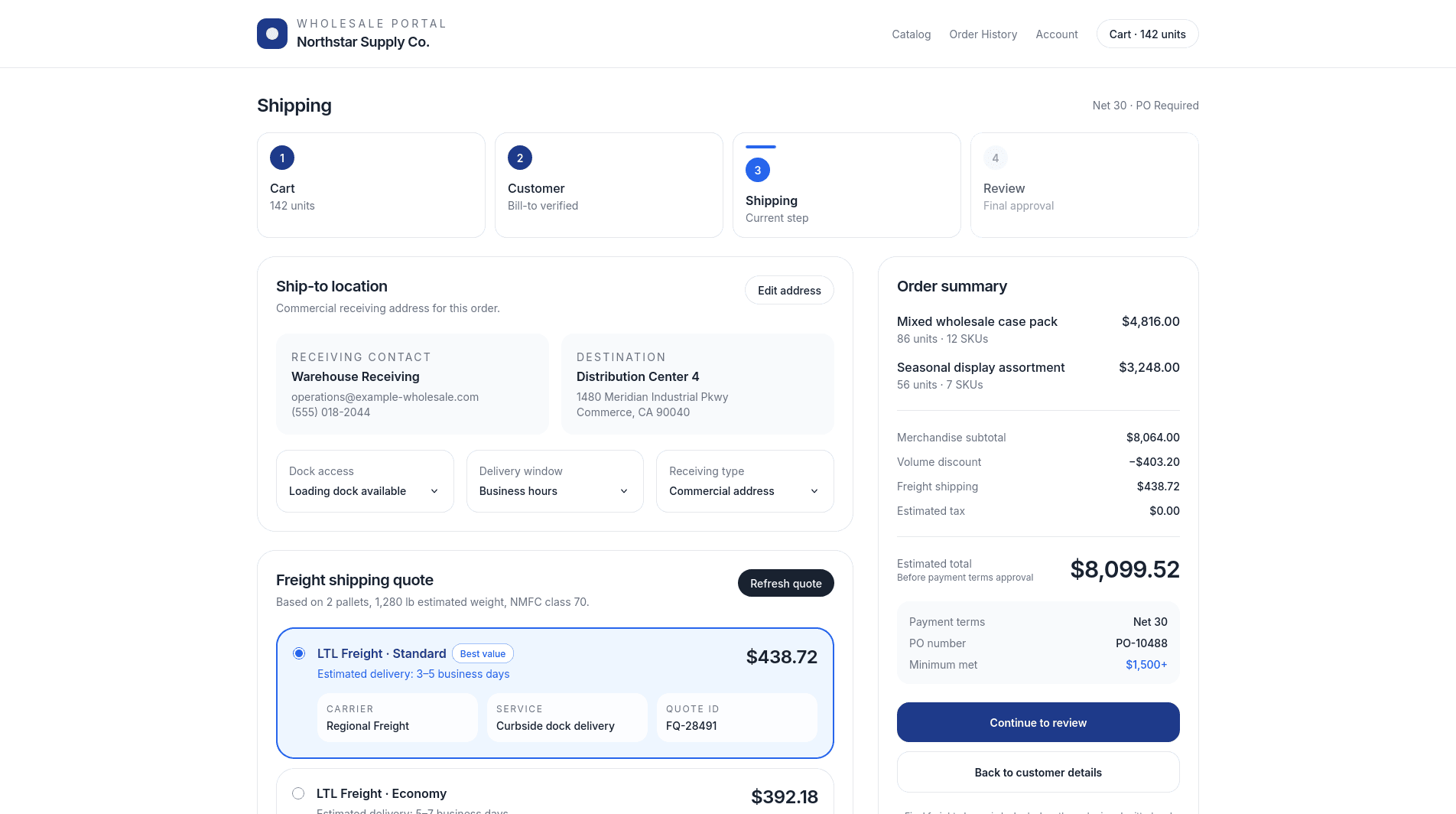
Real carrier rates pulled at checkout from the freight supplier's quote interface. Customers saw the actual cost for their specific order — not a buffer, not an approximation.

Buyer Experience

Before

Institutional buyers — purchasing cooperatives and procurement coordinators working from fixed approved budgets — would hit a freight estimate that exceeded what their purchase order allowed and couldn't complete the order. The company heard about it when it happened.

After

Buyers could see a real number before committing. Orders that had previously stalled at the freight line now had an accurate, trustworthy cost to work with.

Technical Approach

Before

The regional freight carrier had no public API. Getting a real rate meant visiting their website and submitting shipment details through a quote form — a manual step that no buyer was going to perform inside a checkout flow.

After

A custom Magento extension automated what a person would do manually: submit shipment details to the carrier's quote form, parse the response, return the real rate to checkout. Invisible to the customer.

The work

Map the checkout, automate the quote, ship the fix.

01
Mapping the problem — checkout flow and carrier relationship

The estimation algorithm had been a reasonable workaround when the store launched. 'Guess high and cover yourself' is a common approach when carrier rates aren't programmatically accessible. But commercial furnishings ship with enough weight and dimensional variation that the guesses were routinely off. The first step was understanding exactly where in the Magento checkout the freight cost was calculated and how the carrier's quote interface worked.

02
Building the integration — automating the quote

With no API available, the integration worked by submitting order details to the carrier's Get a Quote page and reading the returned rate. A custom Magento extension handled this transparently at checkout: collect weight and destination, submit to the carrier, surface the real number. Built and tested solo. The carrier's quote form was the only interface available — the extension made it work without the buyer ever seeing it.

03
Result — a point of contention that disappeared

Once the integration was live, the shipping complaints stopped. Buyers who had been reaching out when an estimate exceeded their budget no longer had that problem — the number they saw was the real one. Orders that had died at the freight line completed. The friction point was simply gone.

Results

EliminatedCheckout friction from freight estimatesInstitutional buyers could complete orders
Live ratesCarrier pricing at checkoutPulled from the carrier’s own quote system
Solo buildCustom Magento extensionScoped, built, and shipped without a team

Start a conversation

Working on something similar?

If a system integration or a custom software build would remove friction from your operations, let’s talk. A real conversation about what you’re trying to fix — before any commitment.

ToDiana Lopezinfo@pixelswithin.comLos Angeles, CA 90404